STIx Speak
The Communication Protocol for Naming Organizational Drag Without Blame
The Story Tax makes hidden organizational drag visible. STIx Speak helps you address it in the room where it is happening, through language grounded in the work, the evidence, the cost, and the next move.
Call the drag. Not the person.
STIx Speak is available exclusively through select The Story Tax bundles, team kits, and licensed programs. It is not sold individually.
From Seeing the Drag to Naming It
The Story Tax explains how a once-valuable leadership pattern can become measurable organizational drag. STIx identifies where that drag is concentrated. STIx Speak brings the framework into the conversation.
The Bill
Understand the measurable cost of leadership habits that have outlived the conditions that made them useful.
The Diagnostic
Identify where behavioral drag is concentrated across the five pillars.
The Field Guide
Name a stuck decision, meeting, handoff, or process without turning the framework into a label for a person.
The Story Tax is the bill. STIx shows where the drag sits. STIx Speak gives people language for the conversation.
A Language for the Work
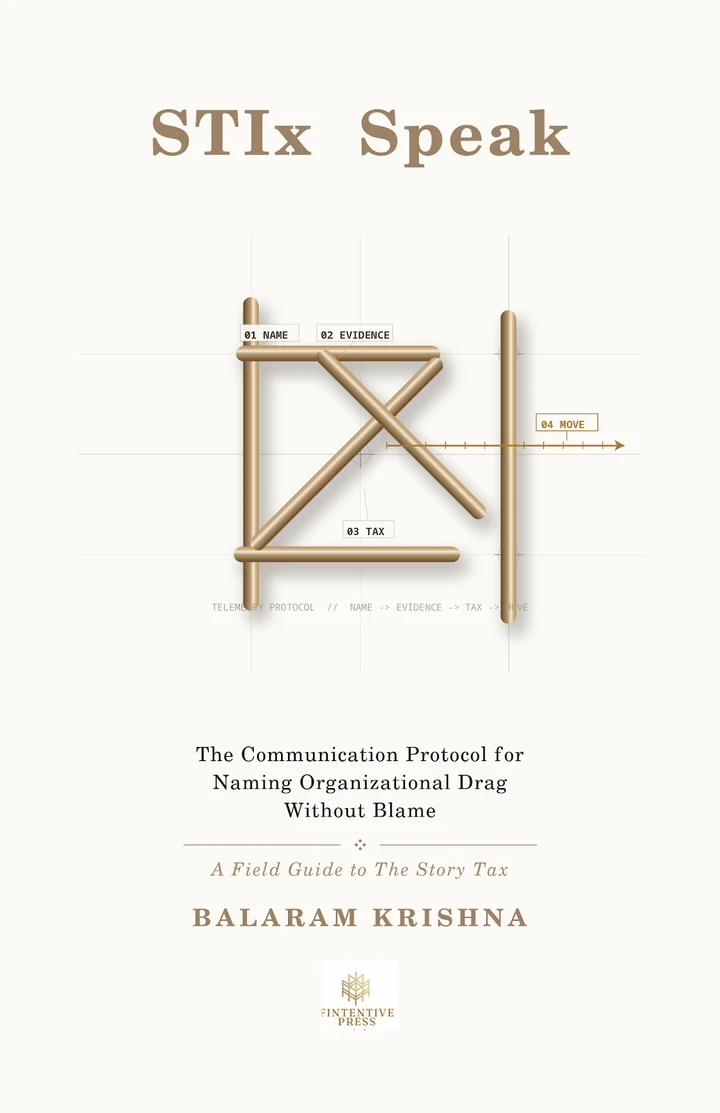
STIx Speak uses a four-part sequence for raising organizational drag in a way that is specific, defensible, and actionable.
-
01
Name
Name one decision, meeting, handoff, or process.
-
02
Evidence
Use facts the listener can check: dates, criteria, records, decisions, and outputs.
-
03
Tax
State the smallest defensible cost the record supports, such as days open, people waiting, or hours spent.
-
04
Move
End with one action a named person can take, with a date or condition attached.
NAME → EVIDENCE → TAX → MOVE
The Five Pillars, Applied in Conversation
Each STIx pillar identifies a distinct source of behavioral drag. STIx Speak shows how to discuss the work without assigning the pillar to a person.
Decision Identity
Presence vs. NecessityConversation objective
Establish the role in this meeting.
Diagnostic question
What specifically requires this leader’s presence?
Delegation Integrity
Authority vs. AppearanceConversation objective
Keep authority with the owner.
Diagnostic question
Did the authority remain with the person who received it?
Meeting Theater
Output vs. ActivityConversation objective
Establish what this meeting produces.
Diagnostic question
What decision, owner, next action, dependency resolution, or operating output should this meeting create?
After-Hours Processing
Closure vs. AnxietyConversation objective
Separate thinking from transmission.
Diagnostic question
Did the message communicate an actual urgency, or did it reopen settled work outside the recipient’s agreed working period?
Speed Signature
Complexity vs. AvoidanceConversation objective
Establish what could still change the decision.
Diagnostic question
What decision-critical information is still missing?
The tension labels describe the framework. They are not used to infer or assign anxiety, avoidance, motivation, personality, or intent to an individual.
Call the Drag. Not the Person.
“You keep taking decisions back.”
“The handoff gave the decision to the project owner, and a second approval was added afterward. Should the authority remain with the owner, or has the boundary changed?”
“This meeting is a waste of time.”
“This meeting is intended to produce a decision and owner. The last two sessions ended without either. Should we redesign it, reduce it, or retire it?”
“You are overthinking this decision.”
“The agreed criteria were met last week. What information is still missing that could change the answer?”
“Stop emailing the team at night.”
“Last night’s message reopened the plan approved earlier that day. Was there a documented trigger, or can the approved plan remain in place until the next review?”
Illustrative lines, not quotations from real people.
Language That Adjusts to the Room
The same organizational drag must be raised differently depending on what the speaker can see, what the speaker can act on, and what the speaker has authority to change.
- One level up
- Three levels up
- Across the table
- Down the organization
- When you are the most junior person in the room
The less authority you have, the later the framework language appears. The vocabulary is optional. The structure is not.
Question → Observation → Evidence → Cost → Intervention
Choose the right setting. Bring evidence. Respect authority boundaries. Close with a specific next move.
What Keeps the Language Safe
No Motive Rule
Say what happened. Leave out why you think the other person did it.
No Label Rule
Attach the framework term to a decision, meeting, handoff, process, or observable pattern, not to a person.
Next Move Rule
Every complete exchange ends with something a named person can do.
For the People Managing the Drag in Real Time
STIx Speak is written for people who can see the drag but need a defensible way to name it: leaders, chiefs of staff, operators, managers, decision owners, and team members working across organizational levels.
- Leaders examining their own operating patterns
- Chiefs of staff turning friction into a specific decision
- Managers working upward, downward, and across functions
- Teams clarifying decisions, authority, meetings, and escalation paths
- Organizations using shared language without turning it into labels
Available as a Companion Edition
STIx Speak is not sold as a standalone consumer title. It is distributed exclusively through authorized The Story Tax bundles, leadership and team kits, and licensed programs.
To read the book it accompanies, start with The Story Tax.
The Language Is Still Being Built
The planned STIx Language Library will collect anonymized, field-tested language for real decisions, meetings, handoffs, and organizational situations, including lines that worked, lines that did not, and the next move that followed.
Situation
One line describing the decision, meeting, handoff, or process.
What was said
The language used, as close to exact as possible.
What happened
The response and the next move.
Privacy: submissions must remove names, company names, identifying titles, locations, scores, and details that could identify a person or organization.
See the Cost. Name the Drag. Move the Work.
Start with The Story Tax to understand the mechanism and measure the cost. Use STIx Speak through an authorized companion bundle or program to take that language into the room.
STIx Speak is available through select bundles, team kits, and licensed programs and is not sold individually.